


Collectivités territoriales : Qui décide de quoi en France ?
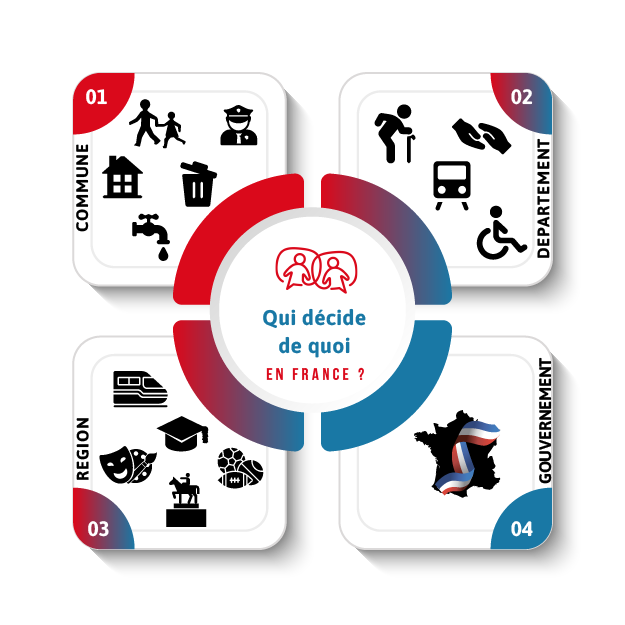
Qui décide quoi en France ? Pas toujours simple de s’y retrouver entre les différentes collectivités territoriales qui existent dans notre pays. A qui s’adresser si je veux obtenir la rénovation d’un gymnase ? Qui peut s’occuper de mon problème de nuisances liées à la route qui passe à côté de chez moi ?
Pour obtenir le plus rapidement possible des réponses, il est important de savoir à qui s’adresser, et d’autant plus lorsqu’on souhaite lancer une pétition en ligne. On fait le point sur le rôle et les compétences des différentes collectivités territoriales en France.
Les communes : au plus près de chez vous !
Commençons par la collectivité territoriale qui est bien souvent la plus proche de vous et donc la plus facilement accessible : la Mairie. Pour synthétiser, on peut dire que c’est la collectivité qui va gérer votre quotidien.
A commencer par tout ce qui est lié à l’enfance : de la gestion des crèches pour les plus petits, aux écoles maternelles et primaires pour les plus grands. C’est également la commune qui va être en charge de ce qui est lié aux loisirs : les accueils de loisirs pendant les vacances par exemple, ou encore les associations sportives ou culturelles.
L’autre compétence principale des mairies concerne tout ce qui est lié à l’urbanisme et l’environnement : via la délivrance de permis de construire ou encore la gestion des voiries appartenant à la Mairie et du Plan Local d’Urbanisme (PLU). Elle est aussi chargée du logement, souvent en lien avec les bailleurs. Si vous avez un problème lié à l’attribution d’un logement par exemple, c’est vers la Mairie qu’il faut se tourner.
Selon les communes et leur taille, d’autres compétences peuvent venir s’ajouter. Tout ce qui est lié à la sécurité notamment, avec pour certaines communes l’existence d’une police municipale, la gestion du stationnement ou encore la prévention de la délinquance. Le nombre d’élus dans les communes varie selon leur taille. Le Conseil Municipal est élu pour un mandat de 6 ans. Le Maire et ses adjoints assurent bien souvent des permanences lors desquelles vous pourrez les rencontrer. Vous trouverez généralement ces informations sur le site de votre ville.
Par exemple, ces deux pétitions ont obtenu la victoire grâce à l’action de leur municipalité :
- Non au projet d'une salle des sports rue d'Alsace, à la place de nos espaces verts
- Pour qu'une place d'Avignon porte le nom du policier Eric Masson, tué dans l'exercice de ses fonctions
L’intercommunalité : depuis 2010, la nouvelle couche du mille-feuille territorial !
Depuis la réforme de collectivités territoriales de 2010, les communes appartiennent toutes à une intercommunalité. Cette nouvelle strate a été pensée dans une logique de rationalisation des coûts et permet de mutualiser certains services entre plusieurs communes. Là aussi, les compétences varient selon les intercommunalités. De manière réglementaire, on retrouve quand même plusieurs compétences, à savoir :
- la collecte et le traitement des déchets
- L’eau et l’assainissement
- La promotion touristique
- Les aires d’accueil des gens du voyage
Les élus des intercommunalités sont élus en même temps que les conseillers municipaux, pour une durée de 6 ans. Vous avez forcément au moins un représentant de votre commune (souvent votre Maire) au conseil intercommunal.
Le département, acteur principal de l’action sociale
Parmi toutes les collectivités territoriales, si vous avez une problématique sociale, c’est certainement le département qui sera le plus à même de vous apporter de l’aide.
Via l’Aide Sociale à l’Enfance premièrement, qui vise à prendre en charge la protection des enfants et de leurs familles lorsqu’ils sont confrontés à des situations précaires ou de mise en danger. Le département accompagne également d'autres populations fragiles comme les personnes âgées ou les personnes en situation de handicap via différentes politiques publiques qui varient selon les départements.
Le RSA (revenu de solidarité active) est aussi un dispositif pris en charge par les départements. Très concrètement ce sont les départements qui le financent mais ils sont aussi chargés d’accompagner les bénéficiaires et de mettre en place des programmes d’insertion. Outre ce plan social, les départements sont mandatés pour s’occuper des collèges, de la voirie qui appartient au département ou encore des transports routiers et scolaires hors milieu urbains.
Les élus du conseil départemental sont les conseillers départementaux, ils sont élus pour une durée de 6 ans. Votre ville fait partie d’un canton qui possède deux représentants (un homme et une femme) au sein du conseil départemental. Comme les communes, vos conseillers départementaux tiennent certainement des permanences lors desquelles vous pourrez les rencontrer.
Les régions, une collectivité territoriale aux compétences variées
Depuis 2015, les régions sont au nombre de 18 (27 auparavant), cette fusion a donné lieu à un renforcement des leurs compétences. Parmi ses champs d’actions, on retrouve tout d’abord les transports avec principalement la gestion des transports ferroviaires. Elle participe notamment au financement des infrastructures, comme la construction et l'entretien des lignes ou des gares. Par exemple, si vous rencontrez un problème de fermeture de la ligne de train que vous empruntez habituellement pour aller travailler, c’est la région qui sera la plus à même de toutes les collectivités territoriales à vous répondre !
La région a également pour mission première l’éducation et la formation professionnelle. Sur l’éducation, à la différence des départements, les régions ont en charge les lycées et les CFA (Centres de formation des apprentis). Concrètement, cela se traduit à la fois par la construction et l’entretien de ces structures, et par la gestion du personnel exerçant dans ces établissements.
Chez MesOpinions, nous avons eu l’exemple d’une pétition dont l’auteur demandait à ce que le choix du terrain d’implantation d’un nouveau lycée soit revu. Après avoir monté un collectif et lancé leur pétition qui a réuni 800 signatures en l’espace de quelques jours, ils ont sollicité la région pour leur faire part de leurs craintes et le projet d’implantation a finalement été revu.
Le troisième champ d’action principal des régions concerne le développement économique. Elle intervient notamment via la distribution d’aides financières allouées aux entreprises, pour les inciter à s’implanter sur le territoire régional par exemple. Elle régente aussi la distribution des fonds européens. En plus de ces missions principales, les régions définissent le schéma d’aménagement et de développement durable du territoire et assurent la protection du patrimoine (via la restauration de bâtiments protégés par exemple). Comme pour les autres collectivités territoriales dont nous avons parlé plus haut, les régions au-delà de ces compétences réglementaires, sont souvent actives sur d’autres domaines. La plupart des régions ont par exemple dans leur équipe exécutive quelqu’un en charge du sport et de la culture.
Le nombre de conseillers régionaux varie selon la taille de la région mais généralement, la représentation du territoire est assurée, vous devriez donc avoir un élu de votre secteur au sein du Conseil régional !
Et le Gouvernement dans tout ça ?
Lorsque vous avez une cause à défendre, il peut être tentant de vous adresser directement aux plus hautes autorités : le ou la ministre chargé(e) de votre sujet, voire le Président de la République lui-même. Selon le sujet, cela peut être pertinent. Sachez simplement qu’il sera plus difficile de capter l’attention de ces personnalités influentes (et demandées!).
La Préfecture, quand à elle, représente l'Etat dans la région ou le département concerné. Autrement dit, le préfet et les sous-préfets assurent la direction des services de l'Etat dans la collectivité. Ces institutions peuvent être contactées en parallèle d'un interpellation départementale ou régionales afin de donner une portée nationale à votre combat.
Si votre objectif est d’empêcher une construction dans votre commune, la priorité sera d’adresser votre pétition et vos interpellations aux élus locaux (voir plus haut dans l’article), riverains, et autres personnes directement concernées. Si, au contraire, votre ambition est de réglementer l’implantation d’usines dans des zones particulières, le ministère responsable de cette thématique pourra être pertinent. Le combat sera plus long et il sera plus complexe de vous faire entendre, mais il est capital de bien comprendre à qui vous devez vous adresser pour atteindre votre objectif. La bonne question à se poser est “Qui peut faire changer les choses et accéder à ma demande ?”. A chaque fois que vous lancez une pétition, c’est cette question clé qui vous permettra d’optimiser vos efforts !
Comment entrer en contact avec des élus ?
Après avoir identifié la collectivité territoriale qui était la plus compétente pour vous aider, il faudra que vous rentriez en contact avec un élu. Vous pouvez le choisir, soit parce qu’il a une délégation en lien avec votre problématique, (par exemple concernant un problème de gymnase, l’adjoint chargé des sports dans votre ville paraît être la bonne personne pour vous aider). Soit, vous pouvez choisir un élu qui représente votre territoire au sein du conseil départemental ou régional. En fonction de votre combat et des demandes qui en découlent, il faudra choisir la collectivité puis la personnalité la plus pertinente.
Les sites internet des collectivités territoriales permettent généralement de pouvoir entrer en contact avec les élus. N’hésitez pas en plus à solliciter un rendez-vous en physique, par exemple lors des permanences tenues par les élus. Aussi, bon nombre d’élus détiennent désormais un profil sur Twitter, Facebook, ou d’autres outils numériques. N’hésitez pas non plus à les interpeller sur ces plateformes publiques, afin d’obtenir une réponse plus rapidement.
Nous vous conseillons de leur présenter votre pétition lorsque vous aurez déjà réussi à mobiliser et à obtenir un nombre de signatures qui vous satisfait. Le « bon » nombre de signatures dépend avant tout de la nature de votre combat mais il n’est pas forcément nécessaire d’obtenir des milliers de signatures pour que votre pétition devienne un argument crédible à votre combat.
Si vous ne savez pas comment vous y prendre ou si vous avez besoin de conseils pour savoir qui solliciter, n'hésitez pas à contacter notre équipe d’experts qui pourra vous accompagner.